Getting Lost Between Hidden Passages and Old Stones in Vieux Lyon
"I arrived in Vieux Lyon expecting beautiful old streets, but what I found felt far more personal. Behind colorful Renaissance buildings and quiet cobblestone alleys, I discovered hidden passageways called traboules that carried whispers of history through the city. Walking there felt less like sightseeing and more like slowly stepping into another century."

~5 - 7 Jam
Pagi hari (08:00 - 10:30)
Pusat Lyon / Akses Transit Utama
Arriving in a District That Felt Untouched by Time
The morning air in Lyon carried the smell of fresh bread and cold stone after light rain. I crossed the Saône River slowly, watching the reflections of old buildings dance on the water. On the other side stood Vieux Lyon, the historic heart of the city and one of the largest Renaissance districts in Europe.
At first, it felt quiet.
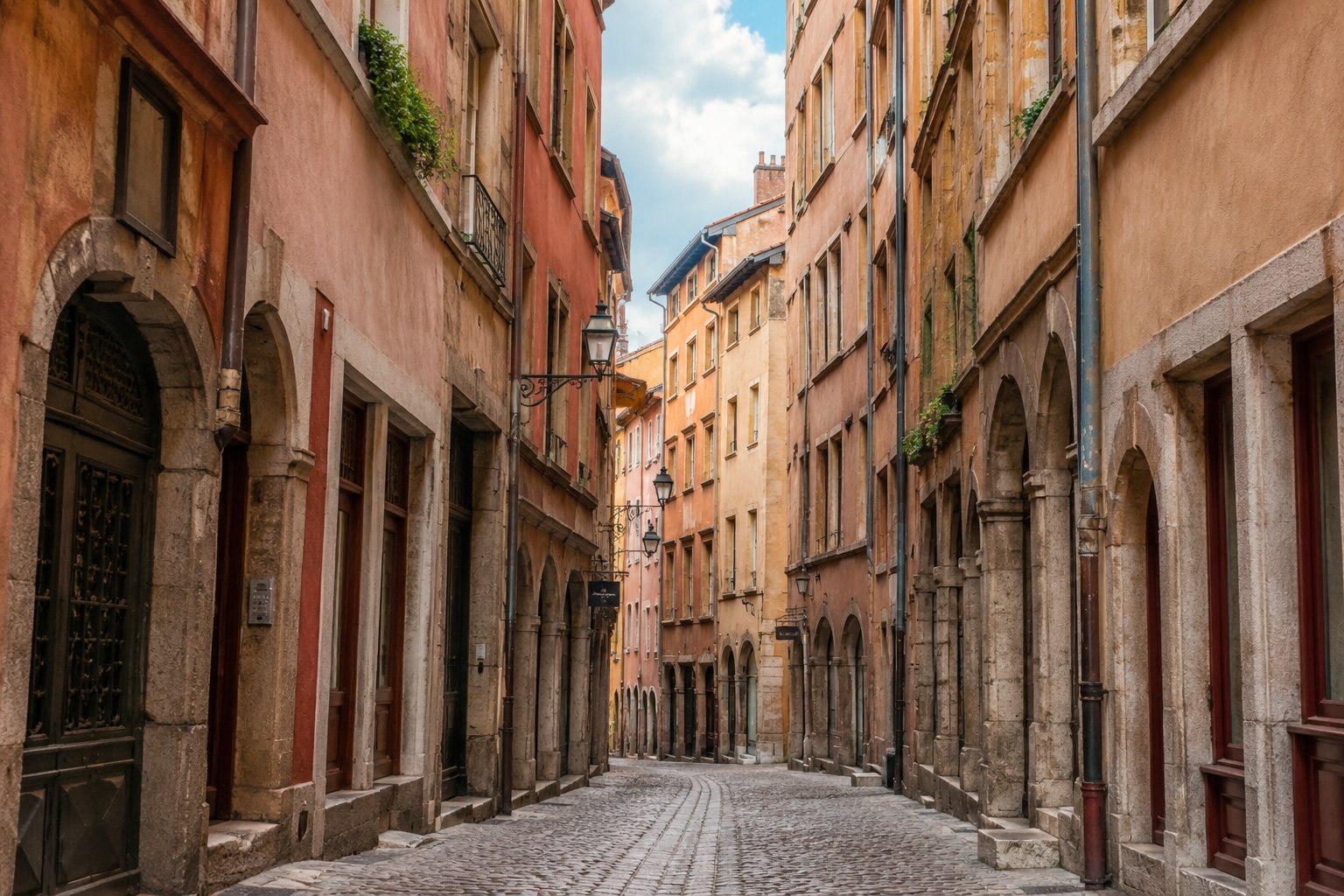
No giant billboards. No modern glass towers. Only narrow cobblestone streets, faded orange walls, wooden windows, and centuries-old buildings standing close to one another as if protecting old memories.
I remember hearing my footsteps echo softly through the alleyways. Every corner looked cinematic without trying to be. Laundry hung from windows above cafés. Tiny bakeries released the smell of butter into the streets. Somewhere nearby, church bells rang slowly across the district.
It did not feel staged for tourists.
It felt alive.
The Moment I Found My First Traboule
Hidden Passages Behind Ordinary Doors
What fascinated me most about Vieux Lyon were the traboules secret passageways connecting streets through hidden courtyards and narrow corridors.
From the outside, many entrances looked like ordinary doors.
I almost walked past my first traboule near Rue Saint-Jean until I noticed a small sign beside an old wooden entrance. Inside, the noise of the street disappeared immediately. The corridor became colder, quieter, and dimly lit by soft natural light from above.
Stone spiral staircases curved upward like scenes from an old film. Tiny courtyards opened unexpectedly between buildings. The walls carried scratches and textures shaped by hundreds of years of footsteps.
For a few moments, I was completely alone there.
And somehow, that silence became my favorite memory of Lyon.
I later learned that these traboules were once used by silk workers to transport fabrics through the city while avoiding rain. During World War II, some were also used by the French Resistance.
Knowing that history made every hidden passage feel even more meaningful.
Wandering Without a Map Became the Best Part
Every Street Had Its Own Personality
The beauty of Vieux Lyon is difficult to fully explain because it is not only about landmarks. The district itself is the experience.
I spent hours simply wandering without direction.
One alley led me to a tiny bookstore with wooden shelves older than my grandparents. Another street opened into a quiet square where local musicians played violin beside outdoor cafés. I stopped for lunch at a traditional bouchon lyonnais, the small family-style restaurants Lyon is famous for.
The waiter spoke limited English, and my French was almost nonexistent, but somehow the interaction felt warm and genuine. He recommended quenelles, a traditional Lyon dish, and smiled proudly when I said it tasted incredible.
Travel sometimes becomes memorable not because of famous attractions, but because strangers make a place feel welcoming.
That afternoon, I climbed toward Fourvière Hill and looked back over the red rooftops of Vieux Lyon. From above, the district looked like a maze of terracotta, church towers, and narrow hidden streets frozen between centuries.
I stayed there longer than I planned.
The city below moved slowly, and for once, I did too.
Best Things to Do in Vieux Lyon
Explore the Traboules
The hidden passageways are one of the most unique features of Lyon. Many are open to the public during daytime hours.
Visit Saint-Jean Cathedral
This Gothic cathedral stands in the center of the district and is famous for its astronomical clock.
Eat at a Traditional Bouchon Lyonnais
Lyon is considered the gastronomic capital of France, and local bouchons offer authentic regional dishes.
Walk Along the Saône River
The riverside becomes especially beautiful during sunset when the old buildings reflect golden light onto the water.
Climb to Fourvière Basilica
The viewpoint above Vieux Lyon offers one of the best panoramic views in the city.
Travel Tips for Visiting Vieux Lyon
How to Get There
By Metro
Take Metro Line D and stop at Vieux Lyon - Cathédrale Saint-Jean Station. The district is directly accessible from the station.
From Lyon-Saint Exupéry Airport
The Rhône Express tram connects the airport to Lyon Part-Dieu Station, followed by a metro ride to Vieux Lyon.
Walking Around
The best way to explore Vieux Lyon is entirely on foot because most streets are narrow and pedestrian-friendly.
Best Time to Visit Vieux Lyon
Spring (April to June)
Pleasant temperatures and fewer crowds make spring one of the best times to visit.
Autumn (September to October)
The weather stays comfortable, and the golden autumn colors make the old district even more atmospheric.
Early Morning or Evening
Visiting early morning allows you to enjoy the quiet streets before tourist crowds arrive.
Entrance Fees
Vieux Lyon District
Free to explore.
Traboules
Most public traboules are free to enter.
Fourvière Basilica
Free entry, though donations are appreciated.
Funicular Ticket
Around €2–3 for a one-way ride depending on Lyon public transport fares.
Local Culture & Etiquette
Greet People Politely
In France, greeting shopkeepers with “Bonjour” before asking questions is considered respectful.
Respect Residential Areas
Many traboules pass through residential buildings, so visitors should keep noise levels low.
Take Time While Dining
Meals in Lyon are often slow and social. Rushing through dinner can feel unusual in local culture.
Final Thoughts
Vieux Lyon did not overwhelm me with grand attractions or loud entertainment.
Instead, it quietly stayed with me.
Maybe it was the hidden traboules, the sound of church bells between old buildings, or the feeling of walking through streets that survived centuries without losing their soul.
Some places impress you immediately.
Vieux Lyon slowly enters your heart without asking permission.
Cerita ini dikurasi dan diverifikasi sesuai Standar Pedoman Komunitas & Editorial PT Locallytrip Teknologi Indonesia.
Beri inspirasi ke sesama traveler! 🌍
Bagikan cerita otentik ini ke media sosial favoritmu dalam sekali klik.